
 (408) 947-1111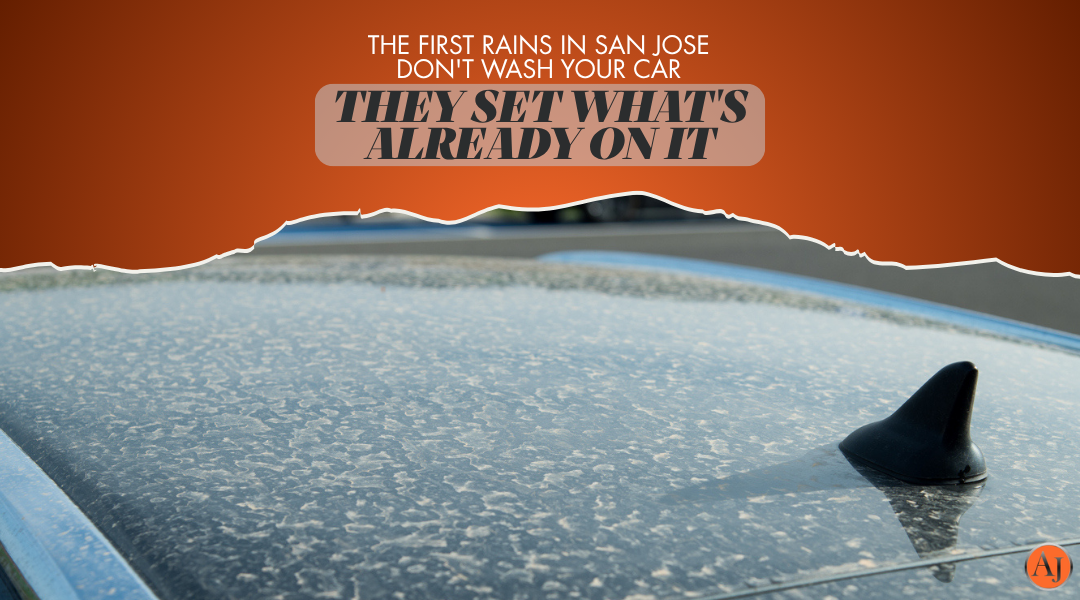
The first real rain of the season feels like a free car wash. It isn’t. Water lands on a summer’s worth of tree sap, bug protein, brake dust and ash, softens it, spreads it into a film, then dries and leaves the whole mess bonded a little tighter than before.
October is the month to strip that off. San Jose gives you a narrow window. Rain here arrives slowly and then all at once. AJ Professional Detailing has been washing and correcting paint on Coleman Avenue since 1985, and the cars that come in clean in autumn are the ones that look right in February. Waiting until the wet weather starts means working around it.
Quick Summary: Key Takeaways
- Rain concentrates contamination, it doesn’t remove it: every drop dries and leaves what it carried behind.
- Bonded contamination needs mechanical removal: sap, tar and bug residue don’t come off with soap, and a clay treatment does what pressure can’t.
- Wheels show it first: baked-on brake dust becomes far harder to remove once winter road film goes over the top of it.
- Glass is a safety item in the rain: a contaminated windshield scatters headlight glare and makes wipers judder.
- Protection works best on clean paint: sealing dirt in is worse than leaving it uncovered.
Rain Activates What’s Sitting on Your Paint
Rainwater picks up whatever is in the air on the way down and whatever is on your car when it lands. It pools. It evaporates. The dissolved solids stay behind as a ring baked into the clear coat. That’s why a car left out through a light shower comes out spotted instead of clean.
San Jose’s timing makes it worse. By NOAA’s 1991 to 2020 climate normals, the city averages just 0.53 inches of rain in October, 1.33 in November and 2.29 in December. Those first thin rains are the dirty ones. Enough water to wet the car and mobilize the grime, never enough to rinse it away.
A Summer of Sap and Bug Residue Has Bonded to the Clear Coat
Park under a valley oak on a Willow Glen street for three months and you end up with a paint surface that has things chemically attached to it, not merely sitting on it. Sap etches. Bug protein and bird droppings are acidic and start eating into clear coat within days in the heat. Tar from the 101 and 880 shoulders welds itself on.
Soap won’t touch any of that. Not once, not ten times. Run your fingertips over the hood after a wash. Feels like fine sandpaper? That’s embedded contamination standing proud of the paint. A clay bar and wax treatment shears it off mechanically, and it’s the step people skip right before they wonder why their new coating didn’t bond.
Protection Only Works on a Surface That’s Actually Clean
Sealing a dirty car is worse than sealing nothing at all. Whatever is on the paint gets locked under the layer you just paid for, and it keeps working on the clear coat from underneath where no wash can reach it.
So the order matters: wash, decontaminate, correct if needed, then protect. We work with Koch Chemie and System X products, which is the boring but genuine reason the results hold up through a wet winter. Sequence beats product every time. Anyone selling you a coating without the prep is selling you a nice-looking mistake.
Wheels, Wheel Wells and Glass Belong in the Exterior Detail
Brake dust is iron. It embeds into wheel finishes, and once winter road film settles over the top of it, what should have been an hour turns into a much longer job. Autumn is the cheap time to reset them, and none of it is a separate booking — wheels, wells and glass are part of the exterior detail.
Glass earns the same attention for a plainer reason. A windshield carrying a film of oily residue scatters oncoming headlights in the rain and makes wipers chatter, and with sunset arriving earlier every week you’ll be doing more of your driving in exactly those conditions. If you’re washing the car weekly anyway, a wash pass is the cheaper way to keep on top of it.
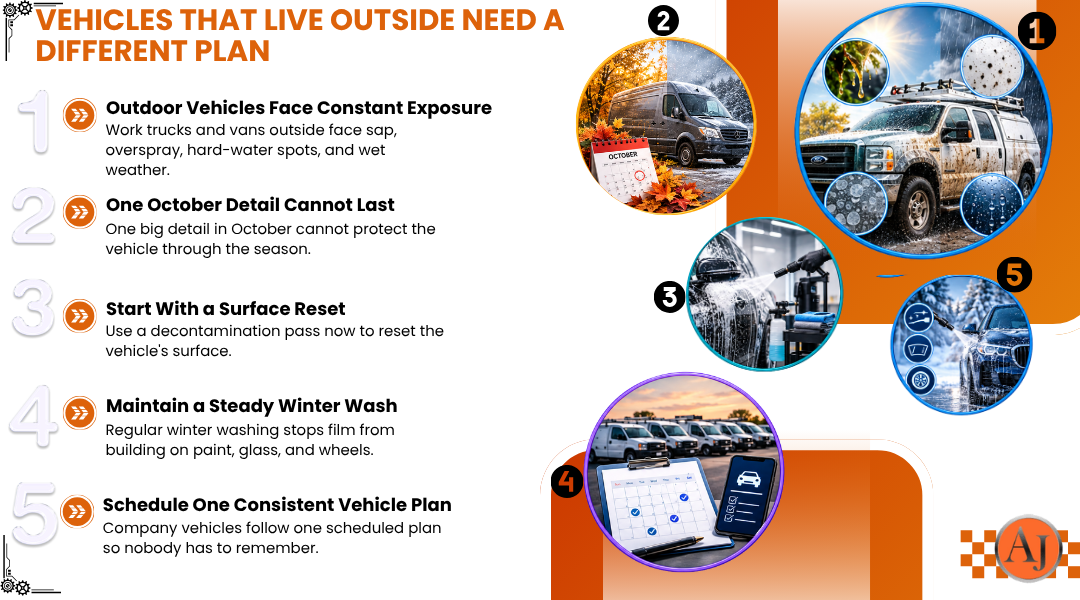
Vehicles That Live Outside Need a Different Plan
Work trucks and vans that never see a garage take the season on the chin. Sap, sprinkler overspray, hard-water spotting from parking-lot irrigation, then five months of wet.
For those, one big detail in October isn’t the answer. A decontamination pass now to reset the surface, then a steady wash rhythm through the winter so film never gets a chance to build up on the paint, glass and wheels at the same time. We handle company vehicles the same way — one plan, scheduled, so nobody has to remember.
Frequently Asked Questions
Q: Should I detail my car before or after the rainy season?
A: Before. Detailing after months of rain means removing everything the wet weather bonded to the paint. A decontamination and protection pass in October means the winter arrives on a clean, sealed surface.
Q: Does rain damage car paint?
A: Rain itself is fairly harmless. The damage comes from what it carries and what it dissolves off your paint — dust, industrial fallout, bird droppings and sap — which concentrate as the water evaporates and etch the clear coat.
Q: How often should I wash my car in the winter in San Jose?
A: Every week or two if it lives outside. The goal is to stop road film and mineral spotting from building up, which is far easier than removing it in March.
Q: What is a clay bar treatment and does my car need one?
A: It’s a mechanical decontamination that shears off bonded material soap can’t remove. The test is your fingertips: if washed paint feels rough or gritty, it needs one before any wax or coating goes on.
Book the Autumn Reset Before the Weather Turns
Tell us where the car parks and what’s been falling on it. Under a tree, in a lot, on the street — that changes which steps actually matter for your paint.
AJ Professional Detailing, 702 Coleman Ave, San Jose, CA 95110. Open Monday through Saturday, 8:00 AM to 5:00 PM, and Sunday 8:00 AM to 3:00 PM. Online at ajautodetail.com.